
There was a time when Procter & Gamble was a proxy for the American consumer. If P&G was selling more, the country was doing fine. If it wasn’t, trouble was coming. One company, one read on the whole household.
That instrument has gone quiet, and why it went quiet is the most important consumer story of the decade.
The bellwether broke because the thing it measured split in two.
We pulled P&G’s organic shipment volume for all 44 quarters back to 2016, straight from the company’s SEC filings, and tested it against U.S. consumption. Across the full period, the correlation with the broad consumer economy is statistically indistinguishable from zero. The signal only reappears in the current inflationary regime, and even then it confirms what’s already happening rather than predicting it. P&G no longer reads the consumer, because there is no longer one consumer to read.
A generation ago, the gap was half as wide.
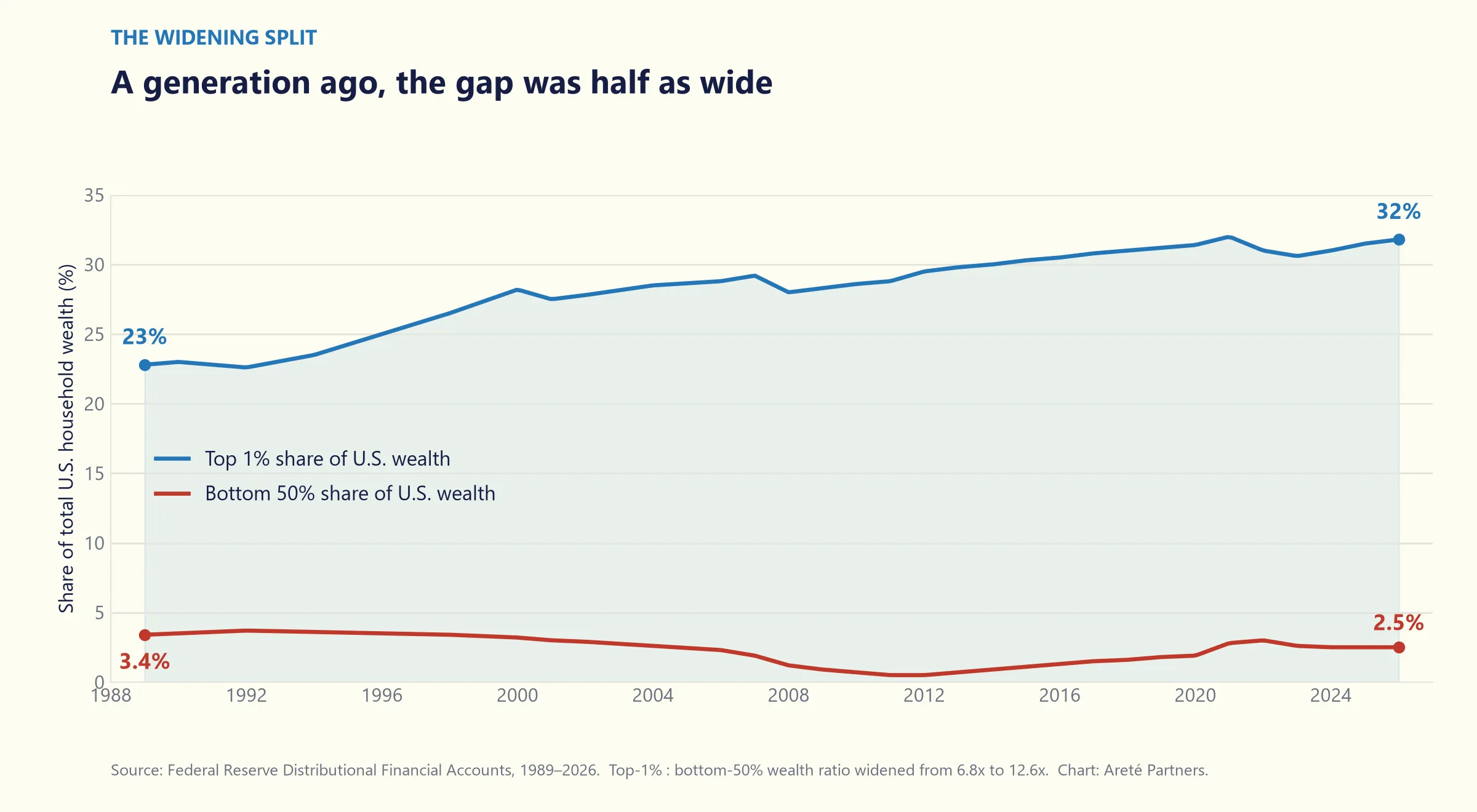
This isn’t a vibe. In 1989 the top 1% held 23% of U.S. wealth and the bottom half held 3.4%, a ratio of roughly 7 to 1. Today the top 1% holds nearly 32% and the bottom half holds 2.5%. The ratio has nearly doubled to 12.6 to 1. Household income inequality (Gini) has climbed every decade over the same window. And the pressure is fresh, not historical: credit-card delinquencies have pushed above their pre-pandemic level even with unemployment low, while the personal saving rate has fallen from roughly 7% to 3%. The bottom half has spent its cushion.
Here’s the part that matters for anyone who owns, lends to, or runs a consumer packaged good brand.
The split doesn’t just divide shoppers. It hides distress inside the income statement.
Watch what happened at P&G through the 2022–24 squeeze. In fiscal 2023, volume, the actual number of units real people bought, fell about 3% on average. But price rose 9%. Net result: reported organic sales grew nearly 7%. To anyone reading the headline, a healthy, growing company. Underneath, real consumption of P&G products was shrinking for six straight quarters.
That’s the fog machine. Price papers over an eroding base. In 14 of the last 44 quarters, P&G’s volume was flat or negative while reported sales stayed positive. The value consumer was quietly walking out the door, and the top-line growth number never flinched.
And the fog is starting to lift, which is exactly the problem.
Pricing power is now spent. P&G’s price contribution has fallen to roughly zero. When you can no longer raise price, the eroding volume base stops being hidden and starts being visible. Every point of lost volume now flows straight to the top line. The distress that inflation concealed for three years is about to surface, and the natural pressure valve for a squeezed value consumer is private label.
The strategic imperative writes itself: brands built for a broad American middle now have to actively fight to keep the value consumer, or cede the bottom half of the market to store brands.
That means real portfolio architecture, not a marketing refresh: defensible entry-price packs, tiered offerings that give the trading-down shopper somewhere to land within the brand, and pack-price strategies that protect volume instead of milking price. The companies that treat this as a pricing problem will keep flattering the top line until they can’t. The ones that treat it as a structural shift, and build for two consumers instead of one, will still have a volume base when the fog clears.
The K-shaped economy isn’t a headline. It’s a harsh warning siren. And it’s getting harsher.
Areté Partners advises owners, lenders, and management teams navigating exactly these inflection points across the consumer and retail landscape. Data in this piece is drawn from P&G SEC filings (FY2016–FY2026) and the Federal Reserve’s Distributional Financial Accounts. Analysis is for discussion, not investment advice.
The Backroom Report from Consumer & Retail is a recurring series from Areté Partners, bringing operator-level perspective to the trends reshaping retail and consumer businesses.